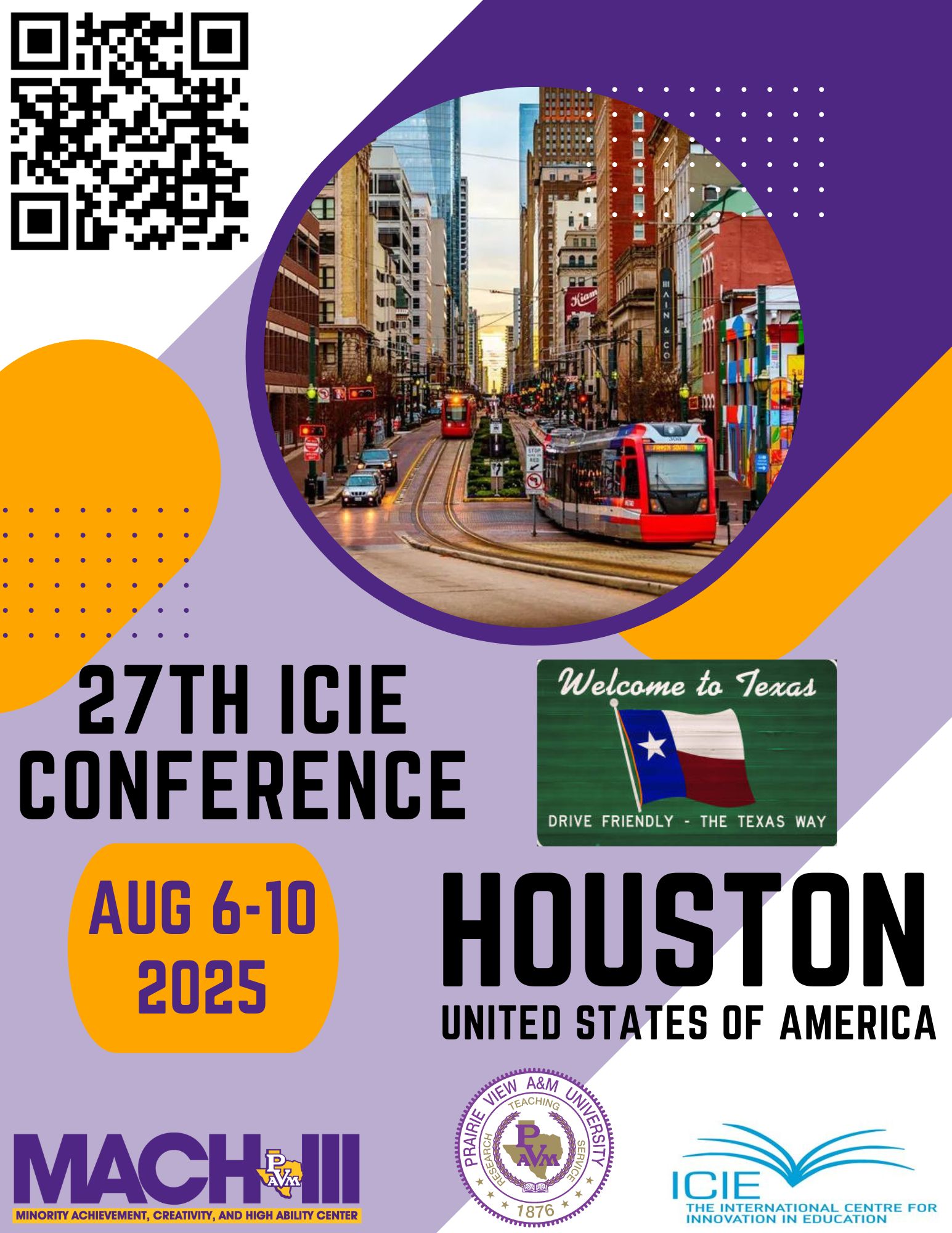
Welcome to the 27th ICIE conference 2025 on:
Excellence, Innovation, & Creativity in Basic-Higher Education & Psychology
Latest Development in Research & Practices
Houston - Texas, USA (December 08 - 12, 2025)
 
Honorary Chair: 
Tomikia P. LeGrande, Ed.D. (President, Prairie View A&M University)

Fred Bonner, Ph.D.                                   Sandra K. Linke, Ph.D.                              Derek Stovin, Ph.D.                              Todd Lubart, Ph.D.            
MACH III Executive Director                                  ICIE Director                                                             ACCESS Education Director                                Université Paris Cité                                     
Conference Chair                                                     Co-Chair                                                                   Co-Chair                                                             Co-Chair                                  
                   

Welcome to the ICIE International Conference

The International Centre for Innovation in Education (ICIE) is committed to the development of all learners as productive world citizens and leaders for the future. This International Conference will provide a conference programme with the highest calibre of: Nobel Prize winners, keynote speakers, invited speakers, and a large number of scholars and presenters alongside a selection of exhibitors. The ICIE conferences are milestones in the journey towards excellence, leadership, creativity and innovation in basic-higher education and psychology.

Conference Aims and Objective
* Encourage volunteer spirit;
*  Promote excellence and sustain quality; 
* Connecting Communities; 
* Strive for improvement; 
* Evolve responsibly; 
* Meet community expectations of quality; 
* Sustain competitiveness and viability; and,
* Balance innovation with core essentials.
 
This conference provides you with the opportunity to: 
* Explore the latest developments in education & psychology in general, and excellence and innovation in education in particular;
* Examine the need for sustainable educational systems;
* Integrate the latest technology into the education system;
* Debate the future of education & psychology: What are the challenges ahead?
* Learn from innovative case studies where educational institutions have taken the initiative;
* Engage in a series of seminars designed to debate the theory and practice of real improvement in education & psychology; and,
* Participate in pre-conference workshops designed to develop participants' competencies.

 
Conference Categories:
  • Excellence in Education: Basic & Higher Education;
  • Gifted Education;
  • Creativity & Innovation;
  • Educational Technology;
  • Educational Reform;
  • Psychology, including all branches (e.g., applied psychology; cognitive psychology; organizational psychology; developmental psychology; experimental psychology; clinical psychology; educational psychology; cross-cultural psychology; positive psychology; social psychology; comparative psychology);
  • Innovative Learning Environment: standards and curricula, tasks and materials, and communication;
  • Instructors and Teacher: competencies, innovative teaching methods, and staff development;
  • Learner: competencies, individual differences, intervention and development;
  • Programme Development: Examples, planning models and components, implementation and evaluation;
  • Global Education for Peace;
  • Organizational & Social Issues in Education;
  • Digitization: Online education; distance education; virtual platforms;
  • Integrated Services: Guidance and counselling, community services, parenting and caring; and mentorship; 
  • Future Trends: Globalisation and networking, civic education, ethical issues; and building creative climates; and,
  • AI.

It is recommended to submit your abstract if your research paper relates to any of the categories mentioned above or it is relating to any of the following sub-categories:
Active Learning; Adult Education; AI in Higher Education; Art and Humanities; Art and Music; Assessment and Feedback; Economics of Education; Capacity Building & Continuous Education; Coaching and Mentoring in Higher Education; Cognitive Psychology and Education; Computer Science; Course Management; Creativity & Innovation; Cross Cultural Studies; Current Issues in Basic Education; Current Issues in Higher Education; Curriculum and Research; Cybersecurity; Early Childhood; Education Policy; Educational Approaches: Teaching for Productive Thinking; Inquiry Based Learning (IBL); Educational Foundations; Educational Policy; Educational Psychology; Educational Research; E-Learning; Engineering Education; Entrepreneurship Education; Environmental Education; Gaming; Global Issues in Education; Health Education; Inclusive Education; Instructional Design and Planning; Language Learning Innovations; Law and Justice; Leadership in Higher Education; Learning Methodologies; Neuropsychology; Organization Creativity; Pedagogies and Teaching Methods in: Medical Sciences; Engineering; Economics & Management; Law; Computer Sciences; Political Science; Quality Assurance and Standards; Research Management; Science Education; Social Media; Social Science; Special Education; Strategic Management in Higher Education; Sustainability; Teaching for Social Justice; Teaching Methodologies; Technology in teaching and learning; Thinking Skills & Executive Functions; and Vocational Education.

We encourage anyone with an interest in: innovation in education, excellence in education, and gifted education to attend this conference. The participants will include: university academics, psychologists, education policy advisers and managers, business and industry leaders, gifted and talented program coordinators, school heads, graduate students, parents and caretakers. 


If you have any question, do not hesitate to contact us:

This email address is being protected from spambots. You need JavaScript enabled to view it.        This email address is being protected from spambots. You need JavaScript enabled to view it.
Designing Our Tomorrow
Ian Hosking & Bill Nicholl
Faculty of Education and the Department of Engineering; University of Cambridge, England
 
 
Designing Our Tomorrow (DOT) is a research collaboration between the Faculty of Education and the Department of Engineering at the University of Cambridge. DOT’s vision is to equip every child with the thinking tools for problem-solving in a complex world. Having worked with students, teachers and other stakeholders in over 10 countries (including England, Eire, Canada and Romania), this presentation critically reflects on DOT’s journey since it started in 2009.
This talk is framed around what we call the 3 A’s: autonomy, ambiguity and authenticity.  Drawing on a number of findings from research projects as well as literature from the fields of creativity, education and design, we reveal how the 3 A’s manifest themselves in classrooms. This talk should be of interest to stakeholders including researchers, teachers and educators in general.
 
Short Biographies
Ian Hosking
Ian joined the Engineering Design Centre at the University of Cambridge in 2009 as a Senior Research Associate after 20 years of working in industry. His current research focuses on understanding and quantifying the neurobiological impact of the visual aspects of designs on people. He is the co-founder and co-leader of Designing Our Tomorrow (DOT) which is a collaboration with the Faculty of Education that develops teaching resources for equipping students with the “thinking tools” to creatively solve real-world problems. He sits on the British Standards Institute Design for All Committee and is a designated national expert contributing to the new harmonised European inclusive design (accessibility) standard.
e-Mail: This email address is being protected from spambots. You need JavaScript enabled to view it.

 
Bill Nicholl
Bill taught Design & Technology (D&T) for 9 years in London high schools.  Bill is currently an Associate Professor at the University of Cambridge where he set up a distinctive course which trains teachers of D&T.  Bill also teaches and supervises MEd/MPhil routes. Bill supervises PhD students on a range of topics including creativity, empathy, assessment, arts in STEAM, masculinities/femininities in design classrooms, across different phases (primary, secondary) and geos (UK, China).  He has been Principal and co-investigator on several research projects and is currently a consultant on an Arts Research Council Research Project which focuses on teaching for creativity in primary (5-11 years) schools.  His research interests are focused on socio-cultural approaches to [design] creativity, empathy and pedagogy. He is co-founder/Director of a research project called Designing Our Tomorrow (DOT) with a colleague from the Engineering Department which has been used in many countries (e.g. Ireland, Canada, Romania).
Bill is on the Advisory Boards for two international Journals and reviews for numerous others. He has many publications including editing a number of books, book chapters and peer-review journals.
e-Mail: This email address is being protected from spambots. You need JavaScript enabled to view it.

Symposium (11)
Various Higher Education Perspectives as they may Relate to Access Education
Karen Magro, Lloyd Kornelsen, Laura Forsythe, Derek Stovin, Ken Reimer
University of Winnipeg, Canada
 
Access Education is a higher education organizational unit in the Faculty of Education at the University of Winnipeg with a mandate to seek to remove, mitigate, and minimize barriers to post-secondary education for adult and other learners who face systemic oppression and who otherwise may not have the opportunity to apply their talents to post-secondary learning.
This symposium consists of a panel of faculty members from the University of Winnipeg who will each give a brief presentation on their current research interests and will then provide some thoughts on how it may relate to Access Education in its current or future iteration.
 
Dr. Karen Magro will speak from an adult education and transcultural learning perspective. Dr. Magro will also share how she is approaching the course she will be teaching for Access Education’s Indigenous Knowledges Post-Baccalaureate Diploma in Education (IK-PBDE) program this Winter Term.
 
Dr. Lloyd Kornelsen will speak from a democratic and global educational perspective and will reflect on how his teaching experience informs Access Education’s pedagogic aspirations.
 
Dr. Laura Forsythe has a new book published entitled Around the Kitchen Table: Métis Aunties’ Scholarship. Dr. Forsythe has been instrumental in the development of Access Education’s IK-PBDE program so, in addition to speaking about her current research interests, will reflect on her experiences teaching in the program.
 
Dr. Derek Stovin will speak from a higher educational leadership perspective. He will draw heavily from Dr. Ken McCluskey’s treatise on educational leadership and consider how elements of his model have been reflected in Access Education’s culture.
 
Dr. Ken Reimer will speak from an inclusive educational perspective. In addition to speaking about his current research interests, he will share his experiences teaching in a pilot program Access Education administers called Build From Within.


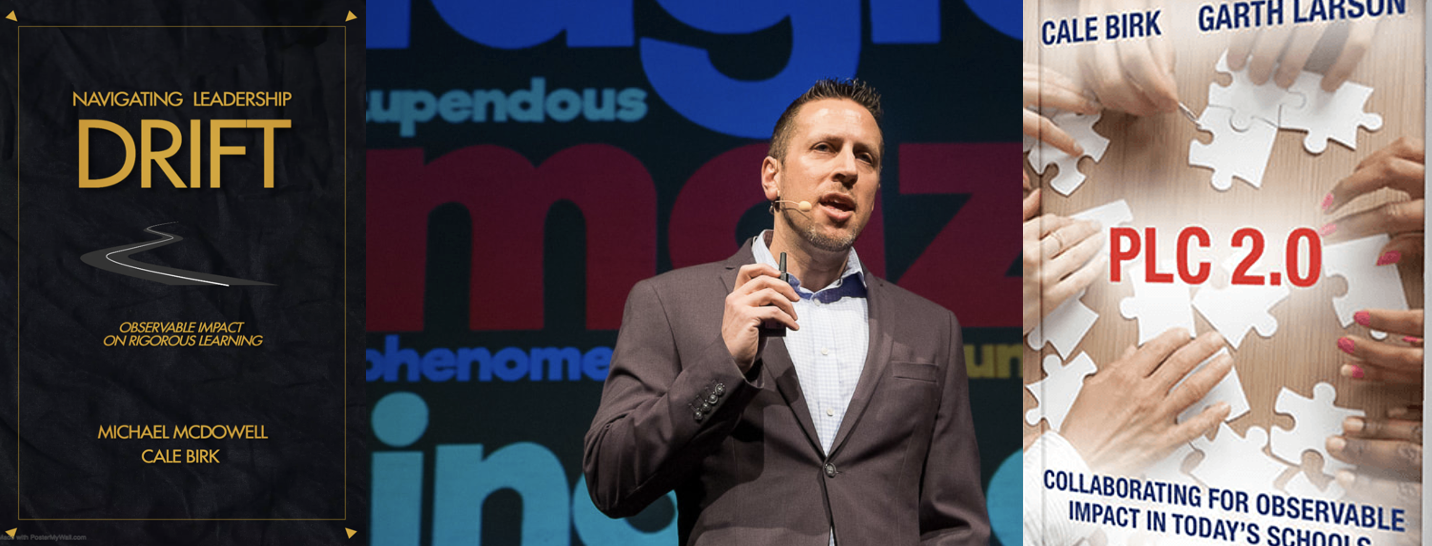
Cale Birk is a former high school Principal, Head of Innovation, Observable Impact Imagineer, and author of “Words on the Wall,” “Navigating Leadership Drift,” “PLC 2.0 - Collaborating for Observable Impact,” “The PLC 2.0 Toolkit,” and “Changing Change Using Learner-Centered Design,” As an educator and leader in the public school system for 25 years, his school was named a model Professional Learning Communities school after increasing student success rates across all grades and subject areas for five consecutive years.
Currently, Cale helps districts, schools and industry leaders answer the question, "What is our observable impact?" and focus on the observable changes in practice that make the difference for each learner and educator. Using the lens of “impact” rather than “action,” Cale has helped leaders and educators reimagine and implement team plans, faculty plans and system-wide strategic plans that engage stakeholders and can be observed where it matters the most–in classrooms with students and teachers. 
 
In addition to his work as an author and facilitator, Cale has been a TED talker and the keynote/featured speaker at national conferences around North America. He has given addresses and workshops in Canada, the United States, Asia, New Zealand and Australia.  In one of his latest projects, Cale is developing a global collaboration/observation network for school leaders from around the world to bring international perspectives, ideas and solutions to instructional challenges in our schools.
 
SM Connections
Twitter: @birklearns
Facebook: Cale Birk
Instagram: birklearns
LinkedIn: Cale Birk

Welcome to the 27th ICIE Conference 2025 on:

Excellence, Innovation, & Creativity in Basic-Higher Education & Psychology

Latest Development in Research & Practices

Houston - Texas, USA (August 8 - 12, 2025)


Page 3 of 11