
Gülşah Batdal Karaduman
Assoc. Prof. Dr. Gülşah Batdal Karaduman, completed her undergraduate studies at the Hasan Ali Yucel Faculty of Education, Istanbul University, majoring in Elementary Teacher Education and Elementary Mathematics Teaching. She earned her master's degree from the Department of Elementary Teacher Training at Istanbul University’s Institute of Educational Sciences and completed her Ph.D. in the Department of Gifted Education at the same university.
Her academic work has focused on mathematics education, differentiated instruction, creativity, and spatial ability. She has presented at numerous national and international conferences on topics such as elementary education, mathematics instruction, creativity, special education, gifted and talented education, and high-order thinking skills. In addition to authoring books, book chapters, and scholarly articles in both national and international journals, she has been actively involved in various research projects.
She currently serves as a section editor for HAYEF: Journal of Education and is a member of both the European Council for High Ability (ECHA) and the World Council for Gifted and Talented Children (WCGTC). She serves as the National Representative of ECHA in Turkey. From 2021 to 2022, she was a visiting professor in the Department of Mathematics Education at the University of Wyoming. Between 2022 and 2023, she held a visiting scholar position in the Department of Educational Psychology at Baylor University. She is currently an Associate Professor at Istanbul University-Cerrahpasa, where she teaches undergraduate and graduate courses, supervises theses, and continues her research on differentiated instruction and creativity in gifted education.
ARCH-III

ARCH‑III stands for the Achievement, Research, Creativity, and High‑Ability Center at Prairie View A&M University. It plays a unique and vital role within the university.
Overview & Mission
- Mission: To produce cutting‑edge best practices and scholarly work addressing contemporary issues affecting key populations—administrators, faculty, and students throughout the P‑20 education pipeline and extending into workplace environments.
- Role: As one of PVAMU’s research centers, ARCH‑III provides a dedicated space for engaged scholarship that centers marginalized voices within an MSI (Minority‑Serving Institution) context.

Distinctive Strengths & Strategic Focuses
- Embedded in an MSI: ARCH‑III’s location within an institution that serves predominantly minorities gives it a direct connection to the communities it supports—distinguishing it from projects carried out in less connected environments.
- Asset‑Based, Voice‑Centered Approach: The center emphasizes an asset‑based perspective—focusing on strengths, potential, and culturally-rooted insights of underrepresented groups rather than deficit narratives.
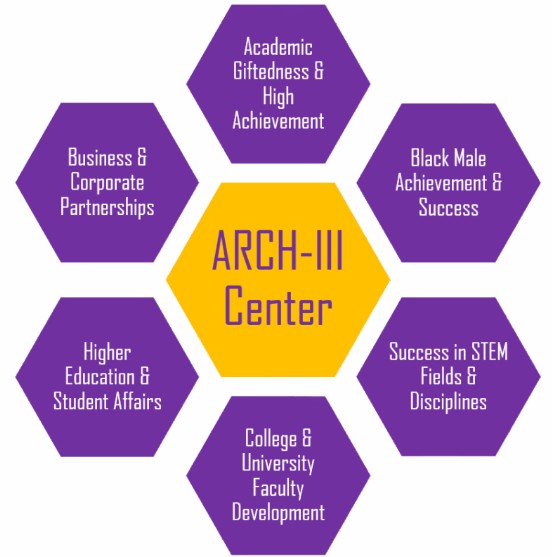
- Six Strategic Research Vectors: ARCH‑III operationalizes its mission through six key vectors:
- Academic Giftedness & High Achievement: Research on the specific needs of gifted underserved students.
- Black Male Achievement & Success: Promoting strategies for resilience and success among Black male students.
- Success in STEM Fields & Disciplines: Supporting the diversification and retention of the STEM pipeline.
- College & University Faculty Development: Enhancing faculty capacity for impactful teaching and student learning.
- Higher Education & Student Affairs: Addressing critical student affairs and institutional issues.
- Business & Corporate Partnerships: Building partnerships to support MSI-focused initiatives and outputs.
Impact & Activities
- The center leads or partners on significant projects, including:
- An NSF-funded HBCU‑UP research initiative aimed at identifying factors that contribute to faculty production of minority STEM graduates.
- Involvement in several funded projects to enhance STEM outcomes, Black male teacher preparation, and faculty resilience.
Why It’s Unique
ARCH‑III stands out because it:
- Operates from within an MSI, providing authenticity and cultural connection.
- Focuses on strength and potential, not just challenges.
- Strategically targets both educational and workforce contexts through interdisciplinary research, faculty development, and corporate engagement.
- Addresses populations often marginalized in research, using their own voices as primary instruments of insight.
In short, ARCH‑III is a specialized center at PVAMU dedicated to transforming the landscape of minority-serving education through research, creativity, and strategic innovation grounded in the lived realities of historically underserved populations.
Would you like more details—like past project outcomes, upcoming programs, or contact info for the center’s leadership team?
Links:
Workshop (5)
Connecting with and Engaging ALL Students: Strategies for Teachers and Project Based Learning
Ken Reimer
Associate Professor, Faculty of Education, University of Winnipeg, Canada
Dr. Racquel Warner
Dr. Racquel Warner is an academic, researcher, and entrepreneur with a dynamic career spanning higher education, sustainability leadership, and executive training. She is known for designing impactful learning experiences that empower students and professionals to thrive in complex, future-oriented environments. She currently serves as the Executive Associate Dean of Academic Quality at Heriot Watt University and she is also a non-resident research fellow at the Mohammed Bin Rashid School of Government, where she worked as an Associate Professor for 6 years. With a research focus on inclusive pedagogy, academic literacy, and the integration of emerging technologies in education, Dr. Warner is a passionate advocate for using AI to enhance equity and engagement in the classroom. She leads a successful corporate consultancy called RAE Consultants and has delivered workshops and keynotes internationally on sustainable leadership, assessment design, and digital innovation in teaching and learning.
Jack A. Naglieri
Jack A. Naglieri, Ph.D. is a former Professor at Northern Arizona University, The Ohio State University and George Mason University and currently Senior Research Scientist at the Devereux Center for Resilient Children. He published 23 books, 51 tests and rating scales, and 300 research papers. He is widely known for his emphasis on innovative approaches to assessment of intellectual ability using tests such as the Cognitive Assessment System-2, Naglieri Nonverbal Ability Tests, Autism Spectrum Rating Scale, Comprehensive Executive Function Inventory and most recently the Naglieri General Ability Tests: Verbal, Nonverbal and Quantitative. He has an extensive test development and research program with emphasis on psychometric quality, equitable assessment, academic interventions and uniting sound theory with equitable scientific practice. He is also the recipient of many professional awards