Christiane, Jeanne Kirsch, Ph.D., holds a Doctorate in Psychology from the University of Luxembourg. Her doctoral thesis explored the typical profiles of creative people in arts, science and everyday life. She continued her postdoctoral studies at the Marconi Institute for Creativity in Bologna, Italy, where she was involved in the CREAM project “Creativity Enhancement through Advanced Brain Mapping and Stimulation”. This project, funded by the European institutions, focalized on the multidisciplinary analysis of the neural substrates that intervene in creativity in different domains of application. In addition to her training in human sciences, she has had professional training in modern-jazz dance at the Espace Pléiade Paris and holds a First Price in jazz dance from the Conservatory of Luxembourg.
Born into a family line of visual artists, she developed an early interest in various artistic disciplines and intended to combine intellectual interests with artistic pursuits. Her research inspires her artistic activities and vice versa. She recently founded the Academy for Creativity and Higher Consciousness in Luxembourg, an institute with a revolutionary approach to psychological counseling, creative expression and personal development (see www.academy-for-creativity-and-higher-consciousness.com). Her current institute, which is presently practice- and intervention-oriented could well be imagined as a prospective research institution, combining research activities with their practical implementation.

Donna Y. Ford, Ph.D., is Professor of Education and Human Development and Cornelius Vanderbilt Endowed Chair at Vanderbilt University.  She is the former 2013 Harvie Branscomb Distinguished Professor and former Betts Chair of Education & Human Development. Dr. Ford currently holds a joint appointment in the Department of Special Education and Department of Teaching and Learning.
Dr. Ford has been a Professor of Special Education at the Ohio State University, an Associate Professor of Educational Psychology at the University of Virginia, and an Assistant Professor at the University of Kentucky.
Professor Ford earned her Doctor of Philosophy degree in Urban Education (educational psychology) (1991), Masters of Education degree (counseling) (1988), and Bachelor of Arts degree in communications and Spanish (1984) from Cleveland State University.
Professor Ford conducts research primarily in gifted education and multicultural/urban education. Specifically, her work focuses on: (1) the achievement gap; (2) recruiting and retaining culturally different students in gifted education; (3) multicultural curriculum and instruction; (4) culturally competent teacher training and development; (5) African-American identity; and (6) African-American family involvement. She consults with school districts, and educational and legal organizations on such topics as gifted education under-representation and Advanced Placement, multicultural/urban education and counseling, and closing the achievement gap.
Professor Ford has written over 200 articles and book chapters; she has made over a 1,000 presentations at professional conferences and organizations, and in school districts.
 
She is the author/co-author of several books, including Gumbo for the Soul: Liberating Memoirs and Stories to Inspire Females of Color (2017); Telling Our Stories: Culturally Different Adults Reflect on Growing Up in Single-Parent Families (2017); R.A.C.E. Mentoring Through Social Media:Black and Hispanic Scholars Share Their Journey in the Academy (2017); Recruiting and Retaining Culturally Different Students in Gifted Education (2013), Reversing Underachievement Among Gifted Black Students (1996, 2010), Multicultural Gifted Education (1999, 2011), Gifted and Advanced Black Students in School: An Anthology of Critical Works (2011). In Search of the Dream: Designing Schools and Classrooms that Work for High Potential Students from Diverse Cultural backgrounds (2004), Diverse Learners with Exceptionalities: Culturally Responsive Teaching in the Inclusive Classroom (2008), and Teaching Culturally Diverse Gifted Students (2005). 
​​
Dr. Ford’s work has been recognized by various professional organizations: Research Award from the Shannon Center for Advanced Studies; the Early Career Award and the Career Award from The American Educational Research Association; Senior Scholar Award and Early Scholar Award from The National Association for Gifted Children; the Esteemed Scholarship Award from The National Association of Black Psychologists; the Outstanding Service Award from the Council for Exceptional Children-The Association for the Gifted. She is the Vanderbilt University SEC Faculty Award recipient (2013). Professor Ford is even more proud and humbled by awards received from student organizations (Black Student Alliance Distinguished Faulty Award, and Jimmie Franklin Outstanding Vanderbilt Faculty Award).
 
Dr. Ford is co-founder of the Scholar Identity Institute (SII) for Black MalesTM, and creator of The Ford Female Achievement Model of Excellence (FAME). Donna is a two-time board member of the National Association for Gifted Children, and has served on numerous editorial boards, such as Gifted Child Quarterly, Exceptional Children, Roeper Review, Journal of Negro Education, Gifted Child Today, and Journal of Educational Psychology. She also reviews for several journals in such disciplines and topics as urban education, the achievement gap, educational psychology, and counseling and development. Professional development includes membership in professional organizations, including the National Association for Gifted Children, Council for Exceptional Children, American Educational Research Association, National Association for Multicultural Education, American Association of Colleges and Teacher Educators, and others.

International Application of the Naglieri General Ability Tests: Verbal, Nonverbal and Quantitative
Jack Naglieri

Tests such as the COGAT, WISC, and NNAT are the three most widely used tests to identify gifted students in the US. These tests are similar in that they all measure general ability but different in test content. The first two require verbal and quantitative academic knowledge which complicates international applications. The NNAT works well internationally but it does not include verbal or quantitative content. The Naglieri General Ability Tests: Verbal (Naglieri & Brulles, 2024), Nonverbal (Naglieri, 2024) and Quantitative (Naglieri & Lansdowne, 2024) were explicitly developed so that the items can be solved using any language, the tests do not require academic knowledge, animated instructions replace long verbal directions, and no oral response is needed from the examinee. The rationale, validity and research support for these new tests will be presented.
 

Reexamining the Role of Gifted Education and Talent Development for the 21st CenturyICIE Renzulli
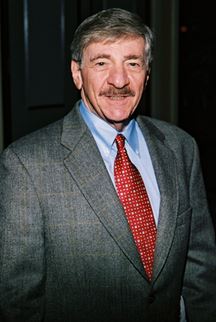
Joseph S. Renzulli
Director, The Renzulli Center for Creativity, Gifted Education,and Talent Development, USA
A discussion of some new research in this field of knowledge, as well as the changing policies and practices in both general and gifted education will be presented in this keynote.
Renzulli (2016) synthesizes the varied school-based applications of his work. These opportunities always resulted in both reflection and the search for answers to questions about what can be done to improve the services to the teachers and students we serve. Although Renzulli’s early work on the Three-Ring Conception of Giftedness and the Enrichment Triad Model gained more attention than expected, he began to believe that there were still characteristics and programming opportunities that needed to be added to the overall search for factors that contribute to a more holistic perspective of talent development.
 

The Underachievement Dilemma and Gifted Girls & WomenICIE Sally Reis

Sally M. Reis
Former Vice Provost of Academic Affairs and a Board of Trustees Distinguished Professor
The University of Connecticut, USA
The underachievement of gifted students is one of the most frustrating issues that teachers and researchers encounter in our field. What causes underachievement?  How can parents and teachers help to develop talents in students who underachieve in school but pursue creative outlets outside of school?  The underachievement of gifted and talented students and the interventions that work for different types of underachievement will be discussed in this keynote, as will the underachievement of gifted girls and women. Suggestions for reversing underachievement will also be discussed.
 

Equity-Based Strategies for Recruiting and Retaining Students of Color in Gifted Education
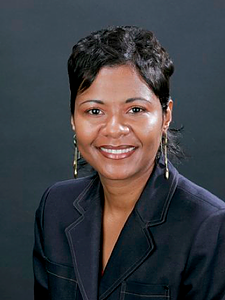
Donna Y. Ford
Department of Special Education & Department of Teaching and Learning; Peabody College of Education​​; Vanderbilt University; Nashville, USA
In the United States, Black, Hispanic, and Native American students are under-represented in gifted education. The demographics of gifted education are shared nationally, along with a summary of state-by-state data by Ford and colleagues. To address this issue of access and opportunity for such students of color, the presenter argues that recruitment and retention efforts must be grounded in equity. Equity-based recruitment and retention strategies are shared, along with a method for quantifying equity in order to set representation goals.


Inventing New Creative and Critical Thinking Strategies Arising from Interdisciplinary Exploration 

Don Ambrose

Rider University in Lawrenceville, New Jersey, USA

Don Ambrose ICIE keynote

A variety of creative and critical thinking strategies are used throughout gifted education programs and to some extent in general education and business and industry. These strategies have been very beneficial. But we can do more! My interdisciplinary explorations have enabled me to discover intriguing constructs in the conceptual terrain of more than 25 academic disciplines and professional fields. With a little creativity, many of these concepts can be turned into new creative and critical thinking strategies. In this session we explore a collection of these strategies, considering how students and adult innovators can use them to energize their work. We'll look at the step-by-step implementation procedures for some of the strategies and examples of their application to various topics. We'll also consider the ways in which the strategies strengthen our creative and critical thinking. Here is a brief sampling of the strategies you will encounter: the invention machine, metaphorical analysis, undermining your own position, chaos-complexity-order analysis, panoramic timeline impact analysis, artistic hypothesis generators, moral-legal overlap analysis, worldview analysis, metapattern analysis, altruistic analysis, aggressive-assertive-passive analysis, macroproblem analysis, intellectual spectrum exploration, personal responsibility determination, and integrative 3D graphic models..

Read a Brief Biography


Creative Thinking in Virtual Reality EnvironmentsTodd Lubart ICIE keynote

Todd Lubart

University of Paris Descartes, France

This presentation will focus on the emergence of multiple user virtual worlds (MUVE) such as Second Life. These platforms offer a range of possibilities that can be used to enhance creative thinking. First a general overview of ways that technology can impact creativity will be presented. Then the presentation will focus on recent work that relates directly creativity and MUVE virtual worlds. A first line of empirical research shows an impact of virtual worlds in terms of the work space, which may facilitate creative thinking. A second line of work shows an impact of the avatars who represent individuals engaged in creative work. A third set of studies indicates that effects on collaborative interactions. Finally, implications for fundamental research and applications such as creativity training and techniques will be proposed.

Read a Brief Biography


Going Global: Reporting Diverse News Stories from an International Perspective 

Jamal Watson

Executive Editor, Diverse: Issues In Higher Education and Lecturer at University Without Walls Program, University of Massachusetts, Amherst, USA

In an age of globalization, U.S. media outlets who cover higher education would do well to expand their coverage to showcase best practices of institutions around the world who are actively working to promote racial, gender and economic diversity. Beyond the occasional stories about study abroad programs, journalists in the U.S. who cover the higher education beat have not done enough to broaden their coverage of international issues and institutions, according to a recent report by the Education Writer's Association. This session will focus on why journalists should expand their news coverage and can help institutions develop news angles to pitch to an international audience.

Read a Brief Biography


Empathic Creativity and Peace Education
Kenneth (Ken) Reimer

Faculty of Education, University of Winnipeg, Canada
We live in a world where problems are getting greater and more complex. We live in a time that is becoming increasingly polarized. Society urgently requires school systems that promote creativity, empathy, and inclusion. Most important, we need to promote PEACE. This presentation explores the potential of merging some of the best components of creativity, empathy, and inclusion into a construct known as “Empathic Creativity” and ways in which it can be taught in schools and used as a means to promote peace education. 


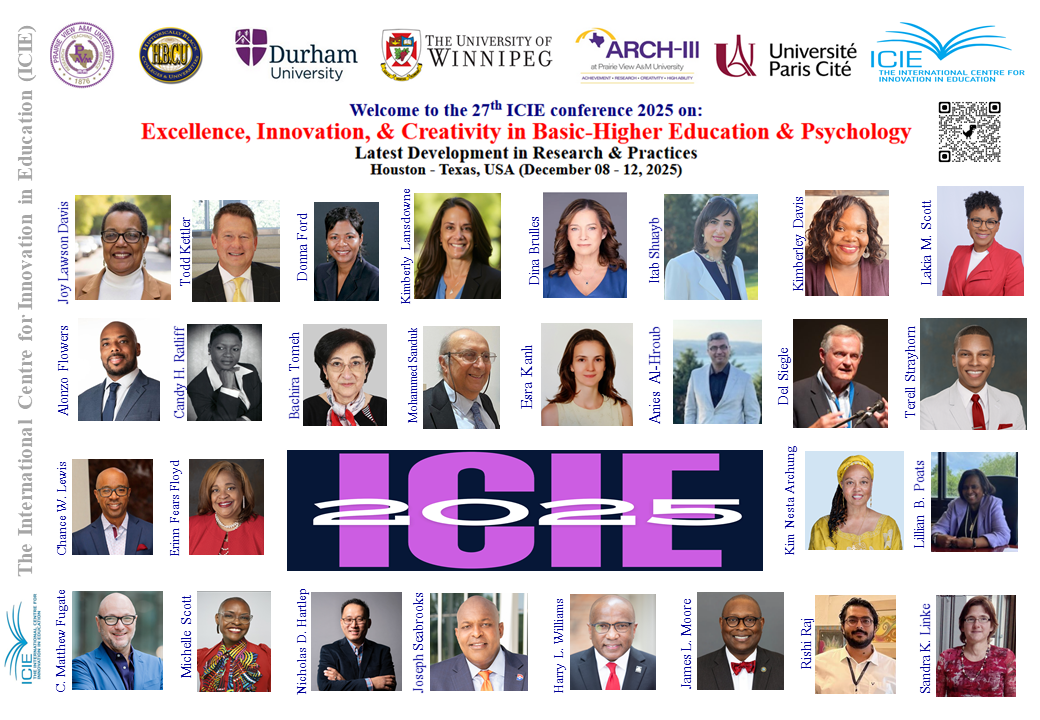
Keynote and Invited Speakers
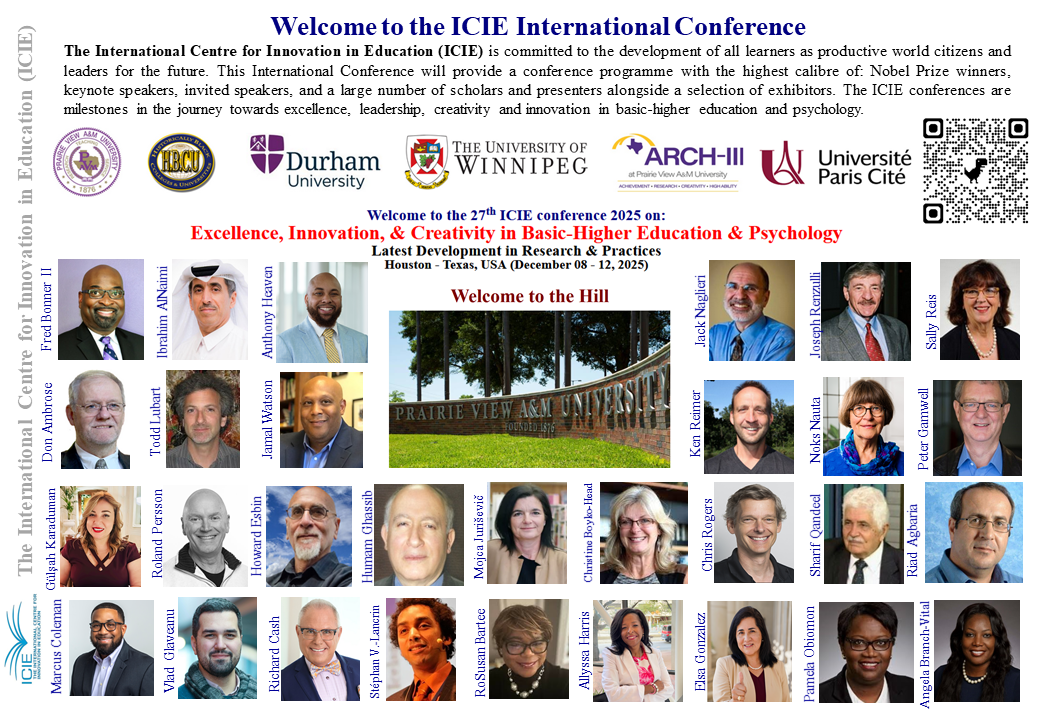
We are honored to welcome a distinguished lineup of keynote and invited speakers who are leaders in their fields and pioneers in innovation education, research, excellence, creativity, gifted education, and other categories. Their expertise and insights will provide valuable perspectives and inspire engaging discussions throughout this international conference (Houston, Texas, 8-12 December, 2025).

African Diaspora Consortium: Kim Archung

ARCH-III Faculty Affiliate: Alonzo Flowers; Donna Ford; Michelle Scott; Javetta Roberson; Nicholas Hartlep; Marcus Coleman; Anthony Heaven; Erinn Floyd

Arkansas Pine Bluff: Kimberley Davis

Baylor: Todd Kettler

Dallas College: Joseph Seabrooks

Diverse Issues in Higher Education: Jamal Watson

Georgia: Tarek Grantham

Gifted Unlimited LLC: Joy Lawson Davis

Kellogg Foundation: Sakinah Harrison

Michigan State University: Jerlando Jackson
National Science Foundation: James Moore

North Carolina-Charlotte: Chance Lewis

Penn State University: Jose Soto

Prairie View A&M University: Pamela Obiomon; Angela Branch-Vital; Carmen Carter; Aashir Nasim; Anton Goff; RoSusan Bartee

TAGT: Matthew Fugate

Texas A&M University: Elsa Gonzalez

Texas Southern University: Lillian B. Poats

Texas Southern: Candy Ratliff

Thurgood Marshall CF: Harry Williams

Virginia Union: Terrell Strayhorn

Yale University: Lakia Scott; Michael Loewenberg

YSEA: Milton Young



Privacy Policy & Data Protection
Thank you for your interest in our website. The protection of your personal data is of major importance for the International Centre for Innovation in Education (ICIE). In accordance to the GDPR, the German Federal Data Protection Act (Bundesdatenschutzgesetz – BDSG), this privacy policy will inform you about the processing of your personal data and/ or submitted information and documents when using this website.
 
The International Centre for Innovation in Education (ICIE) offers a number of websites, including this website, to introduce its international network, events, projects, conferences, capacity building programmes, publications, and journal.
 
The GDPR, the German Federal Data Protection Act (BDSG), as well as further European and German regulations and statutes form the legal basis for the processing of personal/and or institutional data.
 
In reference to the EU General Data Protection Regulation (GDPR), and the German Federal Data Protection Act (BDSG), when you visit this website, your privacy is important to us. Access to your personal data is subject to strict security controls and we will not share it with third parties.
 
All personal data received and stored in the website will be used only in communication with you relating to the ICIE's fields of work, activities, conferences, workshops, publications, journal, and educational/scientific meetings.
 
The ICIE’s General Director, Director, and only designated officials in charge of the International Centre for Innovation in Education (ICIE) have access to your data, which is contained in the website database. Your submitted information, in the conference website, and the journal website, includes: Name, address, e-Mail, and other information relating to your submission. Our websites are hosted in the USA by:
InMotion Hosting;
100 Center Drive; Suite 1190; Los Angeles, CA 90045, USA.
 
If you have any question relating to this website, your submitted data, e-Mail, and any communication with us as a person and/or an institution, contact me:
Prof. Dr. Taisir Subhi Yamin;
General Director, The International Centre for Innovation in Education (ICIE);
Postfach 12 40; D-89002, Ulm; Germany.
Mobile: 0049-152-551-661-45; e-Mail: This email address is being protected from spambots. You need JavaScript enabled to view it.
 
The personal data collected by the website is stored no longer than is necessary for the performance of the purpose for which it was collected (e.g., registration for the conference, submitting your abstracts, registration for capacity building programmes, uploading your research papers and presentations, accessing the ICIE’s publications and journals). If this purpose no longer exists, we will delete or anonymize the data insofar as there are no legitimate reasons or obligations preventing this (e.g., tax regulations). In the latter case, data is only processed to a limited extent, i.e., only to comply with the above mentioned reason or obligation to store data, and also only with consent for the assertion, exercise or defense of legal rights, for the protection of the rights of another natural or legal person, or for reasons of an important public interest of Germany, the European Union (EU) or an EU member state. In the case of an obligation to store data, we shall erase or anonymize the data following certain expiry of the legitimate reason or obligation to store the data.
 
If you register for an event (e.g., the international ICIE annual conference, capacity building conferences and prorammes, distribution of IJTDC journal) we use the data stored in the website database to register you for this event and to hold the event. The data transmitted during registration for an event is required for the preparation and fulfillment of a contractual relationship (event participation). The legal basis for the processing of your data is therefore Art. 6 (1) sentence 1 b) GDPR; and Art. 6 (1) sentence 1 c) GDPR.
 
In addition, I have to inform you that this website uses cookies. By continuing to use this website, you agree to their use. Cookies are small data packages generated by the Web server and stored on your computer’s hard drive during communication between your computer and the Web server. A distinction is made between so-called session cookies, which serve merely to enable the functionality of the website and are immediately deleted when the browser is closed, and so-called persistent cookies, which are stored and used for further sessions. The website uses both types of cookie. The legal basis regarding the processing of your data is Art. 6 (1) sentence 1 a) GDPR.
 
You can exercise your right to reject cookies at any time. Regardless of the other possibilities to prevent cookies, you can achieve this by setting your browser so that it does not accept any cookies or always asks for your approval before placing a cookie. Please refer to the Help function of your browser for more details on this. If you do not accept cookies, you may not be able to use all features of the website.
 
These descriptions also inform you how to prevent persistent cookies.
 
We undertake technical and organizational security measures to protect your personal data against unintentional or unlawful erasure, alteration or loss, and against unauthorized disclosure or unauthorized access.
 
This privacy policy & data protection corresponds to the date stated below. We reserve the right to amend this privacy policy. We would therefore ask you to regularly consult our privacy policy in order to be informed about any possible changes.
 
 
Prof. Dr. Taisir Subhi Yamin;
General Director, The International Centre for Innovation in Education (ICIE);
Postfach 12 40; D-89002, Ulm; Germany. Mobile: 0049-152-551-661-45; e-Mail: This email address is being protected from spambots. You need JavaScript enabled to view it.
 
Ulm, Germany: June 1, 2018 (checked frequently: September 8, 2025)

 
W3
 
Challenges of Curricular Adaptation as Practice of Inclusion and AI Solutions
Loredana Adriana Patrascoiu
University of Bucharest, Romania
Curriculum adaptation is considered as being one of the efficient ways of personalizing the learning through which it is facilitated educational inclusion, it happens that in certain contexts it turns into a barrier for learning and participation, especially when teachers lack the resources necessary to support this process.
In order to widen the range of accessible tools that allow curricular flexibility for students with intellectual disabilities in inclusive school, our case study brings to attention an open access resource, the TactileImages.org platform, which offers the possibility to develop self-described personalized educational materials in an interactive and multisensory format and for many languages.
 
Keywords:
Barriers to learning and participation, curricular adaptation, inclusion, educational platforms


ICIE Awards 2018

The executive committee of the International Centre for Innovation in Education (ICIE), and the organizing committee of the 16th International Conference are pleased to announce the winners of the following awards:


·        ICIE International Award for Excellence in Higher Education:

Prairie View A&M University, Texas – USA.


·        ICIE International Award for Organizational Creativity:

Centre for Educational Research and Innovation (OECD-CERI), France.


·        ICIE International Award for Excellence in Community Service:

Vojko Obersnel (Mayor of Rijeka), Rijeka-Croatia.


·        ICIE International Award for Outstanding Research in Education:

Maciej Karwowski, Warsaw, Poland.


ICIE-MACH III Awards 2019

The executive committee of the International Centre for Innovation in Education (ICIE), and the organizing committee of the 17th International Conference are pleased to announce the winners of the following awards:
ICIE – MACH III Award (2019) for Administrator Excellence in Innovation, Creativity, and Education
¨ Renu Khator (President, University of Houston, Texas, USA)
 
ICIE – MACH III Award (2019) for Community Leaders in Innovation, Creativity, and Education
¨ Don Sowell (Prairie View, Texas, USA)
¨ David Allen (Mayor of Prairie View, Texas, USA)
¨ Sylvester Turner (Mayor of Houston, Texas, USA)
¨ Alma A. Allen (State Representative, Texas, USA)
 
ICIE – MACH III Award (2019) for Excellence in Diversity, Inclusion and Social Justice
¨ Royce West (Senator, Texas, USA)
¨ Cecile Richards
 
ICIE – MACH III Award (2019) for Faculty Excellence in Innovation, Creativity, and Education
¨ Pamela Holland Obiomon (Dean, The Roy G. Perry College of Engineering, PVAMU, Texas, USA)
 
ICIE – MACH III Award (2019) for Innovation in Higher Education
¨ Michael J. Sorrell (President, Paul Quinn College, Texas, USA)
¨ Quinton B. Bullock (President, The Community College of Allegheny County (ACCAC), USA)
¨ Kathaleena Edward Monds (Founding Director, Center for Educational Opportunity (CEO))
¨ Lone Star Community College (LSC)
¨ Houston Community College (HCC)
 
ICIE – MACH III Award (2019) for Leadership in Innovation, Giftedness, & Creativity
¨ Joel McIntosh (Publisher, Prufrock Press)
¨ Texas Association for the Gifted and Talented
¨ Susan K. Johnsen (Editor Gifted Child Today)
¨ James Moore
¨ Tarek Grantham
¨ Ken McCluskey (Dean, Faculty of Education, University of Winnipeg, Canada)
 
ICIE – MACH III Award (2019) for Innovation in P-12 Education
¨ Charles Butt (H-E-B Chairman and CEO, The Holdsworth Center – Texas, USA)
¨ The Kinder Institute for Urban Research (Rice University, Houston, Texas, USA)

Symposium (1):
 
The Minority Achievement, Creativity, and High Ability (MACH-III) Center: Researching the Status of Minority Populations across the P-20 Education Spectrum in the U.S.
Dr. Fred A. Bonner II; Dr. Rishi Raj
Minority Achievement, Creativity and High Ability Center (MACH-III); Department of Educational Leadership and Counseling; Prairie View A&M University, USA


Under the direction of Dr. Fred A. Bonner II, professor and endowed chair at Prairie View A&M University, the mission of the Minority Achievement, Creativity, and High-Ability (MACH-III) Center is to produce cutting-edge best-practices and scholarship that will speak to the contemporary issues impacting our target populations across the P-20 spectrum and beyond into critical workplace contexts. The tripartite focus of the MACH-III Center among critical populations is administration, faculty, and students.  The Center serves as a crucible that will facilitate the combinations of key elements from multiple disciplines and fields.  The contributions of the MACH-III Center to the knowledge base will be operationalized primarily through six strategic foci that are referred to as vectors.  This presentation will provide an overview of the Minority Achievement, Creativity, and High-Ability Center (MACH-III) Center, our unique positionality within the U.S. educational context, and our six strategic areas of research focus.
 
Short Biographies
 
 
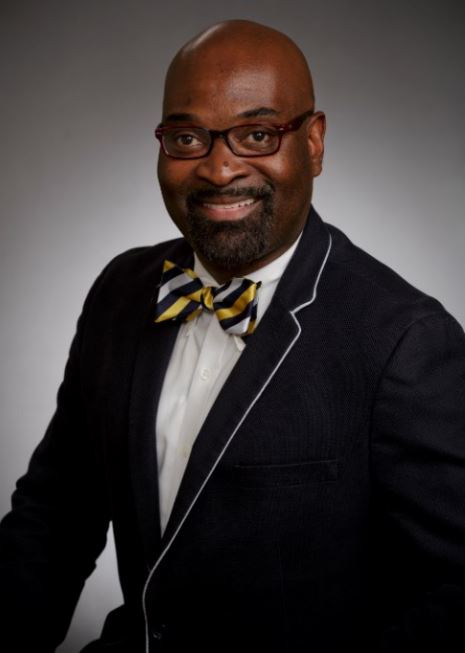
Dr. Fred A. Bonner, II is Professor and Endowed Chair in Educational Leadership and Counseling at Prairie View A&M University.  He is formerly the Samuel DeWitt Proctor Endowed Chair in Education in the Graduate School of Education at Rutgers University and an esteemed expert in the field of diversity in education. Prior to joining Rutgers, he was Professor of Higher Education Administration and Dean of Faculties at Texas A&M University-College Station. He earned a B.A. in chemistry from the University of North Texas, an M.S. Ed. in curriculum and instruction from Baylor University, and an Ed.D. in higher education administration & college teaching from the University of Arkansas.  Bonner has been the recipient of numerous awards, including the American Association for Higher Education Black Caucus Dissertation Award and the Educational Leadership, Counseling and Foundation's Dissertation of the Year Award from the University of Arkansas College of Education.  His work has been featured nationally and internationally. He is the author of the recently released book, Building on Resilience:Models and Frameworks of Black Male Success Across the P-20 Pipeline.
 
 
Dr. Rishi Raj is the Associate Director of the Minority Achievement, Creativity, and High-Ability Center (MACH-III) Center, under the Marvin D. and June Samuel Brailsford College of Arts and Sciences, at Prairie View A&M University, part of the Texas A&M University System. The mission of the center is to produce cutting-edge best-practices and scholarship that speaks to contemporary issues impacting critical populations: administration, faculty, and students across the P-20 spectrum and beyond into workplace contexts. In addition, Dr. Rishi Raj is Associate Editor of the Journal of Minority Achievement, Creativity and Leadership (JMACL) is affiliated with the Minority Achievement, Creativity, and High-Ability Center (MACH-III) Center at Prairie View A&M University. The journal underscores achievement, creativity, and leadership among gifted and high-achieving minority populations across the P-20 continuum and aims to provide a range of information that foregrounds asset-based as opposed to deficit-oriented models for academics as well as practitioners in P-12 and higher education contexts.


Contact Info:
Dr. Fred A. Bonner II; Dr. Rishi Raj
Minority Achievement, Creativity and High Ability Center (MACH-III);
Department of Educational Leadership and Counseling;
Whitlowe R. Green College of Education;
Prairie View A&M University;
W.F. Delco Room 229; P.O. Box 519, Mail Stop 2420; Prairie View, Texas 77446, USA.
Phone: 936.261.3656; Fax: 936.261.3617
 

e-Mail (1): This email address is being protected from spambots. You need JavaScript enabled to view it.

e-Mail (2): This email address is being protected from spambots. You need JavaScript enabled to view it.

Page 10 of 11